
Tax Planning for Surgical Centers in 2026 — Ownership, Depreciation, and Distributions for ASC Physician Owners


An ambulatory surgery center is a different tax animal from a medical practice. The facility typically has multiple physician owners, an entity taxed as a partnership, millions of dollars in equipment and build-out, and income that comes from facility fees rather than professional services. Each of those features carries its own tax treatment — and together they create planning opportunities and traps that surgical centers face and solo practices never see. Here is how the pieces work for 2026.
Entity Structure — Why Most ASCs Are Partnerships

Most surgical centers are organized as an LLC taxed as a partnership — the standard ambulatory surgery center structure nationwide. The entity structure fits the business reality: multiple physician owners with different ownership percentages, the flexibility to admit and redeem partners as surgeons join or retire, and income passing through to each owner's return on a Schedule K-1 without an entity-level federal tax. Some centers use an S-Corp instead, but the partnership form's flexibility on allocations and buy-ins is usually why the ASC world defaults to it.
Pass-through treatment means each owner's personal return carries the center's results — income, deductions, and credits arrive on the K-1, and the owner's basis in the partnership tracks contributions, income, and distributions over time. Basis is not an academic number: distributions beyond basis are taxable, and losses beyond basis are suspended. Every ASC owner should know their number.
Depreciation — the ASC's Built-In Deduction Engine

Surgical centers are equipment-heavy by design — imaging, surgical systems, sterilization, recovery bays. Current law allows substantial first-year expensing of qualifying equipment through Section 179 and bonus depreciation provisions, which turns major purchase years into major deduction years. The planning is in the timing: aligning acquisitions with high-income years, and electing expensing levels deliberately rather than by software default.
The facility itself holds a second, frequently missed layer: cost segregation. A cost segregation study breaks a build-out or facility purchase into components — specialized electrical and plumbing, finishes, equipment foundations — that depreciate over far shorter lives than the building shell. For a center that spent seven figures on construction or tenant improvements, cost segregation routinely accelerates a meaningful share of that spend into early-year deductions. It is an engineering-based study with documentation the IRS recognizes, not an aggressive position — exactly the kind of tool that fits an honest plan.
Built or equipped your center without a cost segregation study?
There may be deductions still sitting in the walls. Schedule a confidential consultation with Tax Wealth Consultant.
taxwealthconsultant.com | (949) 409-8335
Facility Income, QBI, and the Honest Answer

Here is where surgical centers get genuinely interesting. The 20% QBI deduction phases out at higher incomes for specified service businesses — including the practice of medicine. But an ASC's facility fees compensate the use of the facility, staff, and equipment rather than a physician's professional services, and facility income has a credible claim to non-SSTB treatment that a medical practice's fees do not. The determination is fact-specific — it depends on how the center's operations, billing, and services are actually structured — so the honest framing is this: high-earning ASC owners may retain a QBI deduction their practice income lost, but the position must be analyzed and documented for your center, not assumed from a blog post. Ours included.
Distributions, Estimates, and the Owner's Calendar

Because the center pays no federal entity-level tax, owners pay as they go. Distributions arrive quarterly; the tax on the underlying K-1 income is the owner's responsibility through estimated payments, whether or not cash was distributed. The classic ASC surprise is a profitable year with reinvested cash: taxable income with no matching distribution. A distribution policy aligned with projected tax liabilities — and quarterly projections per owner — is basic hygiene for a well-run center.
California adds one more lever: an ASC taxed as a partnership can be a qualifying entity for the state's PTET election, shifting the state tax to the entity level with owners claiming the credit — an election worth modeling annually for a multi-owner group. Owners whose income also flows from their practice should coordinate both returns; the interplay is the same one we map in tax planning for medical practices and the year-round framework in Tax Planning for Business Owners — Strategies for 2026.
How Tax Wealth Consultant Works with Surgical Centers
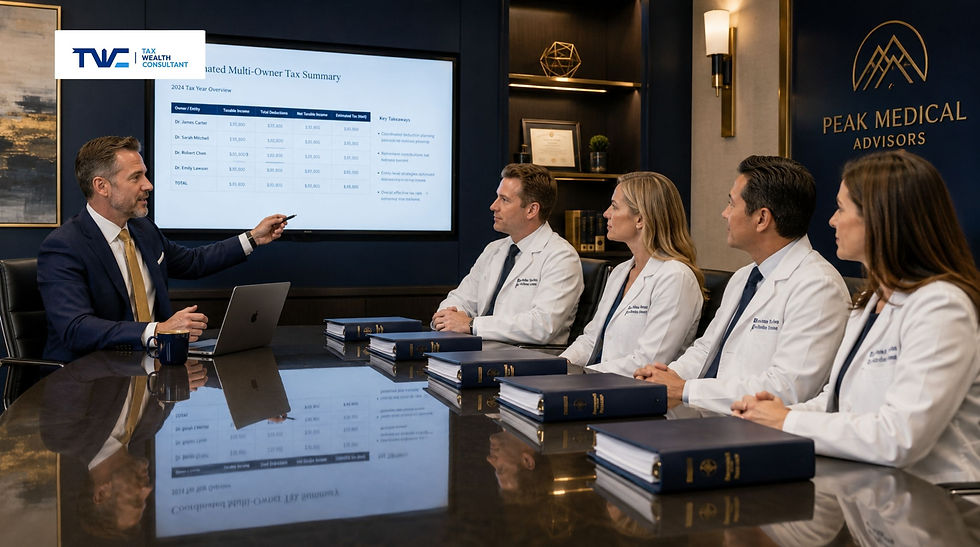
Tax Wealth Consultant treats an ASC as one system with many owners: the entity return, depreciation and cost segregation strategy, the facility-income QBI analysis with documentation, per-owner basis tracking, quarterly estimates for each physician, and the annual PTET decision. We do not promise outcomes, and where a position depends on facts — as the facility-income question does — we analyze your facts before taking it. That is what defensible looks like, and for surgical centers it is also where the real dollars are.
Your center runs on precision. Its tax plan should too.
Schedule your confidential 30-minute review with Tax Wealth Consultant today.
taxwealthconsultant.com | (949) 409-8335
Tax Wealth Consultant provides tax planning, tax preparation, and wealth advisory services for business owners, professionals, and investors in Irvine, Orange County, and beyond.


Comments