
Estimated Tax Payments and Quarterly Tax Planning in 2026 — The Three Questions Everyone Asks First


Income without automatic withholding — business profit, investment gains, rental income, a 1099 — comes with a responsibility many people do not discover until a penalty notice arrives: paying the IRS as the money is earned, not just once a year in April. Estimated tax payments and quarterly tax planning answer three questions almost everyone asks the first time this applies to them. Here are all three, with current IRS rules for 2026.
What Are Estimated Tax Payments?
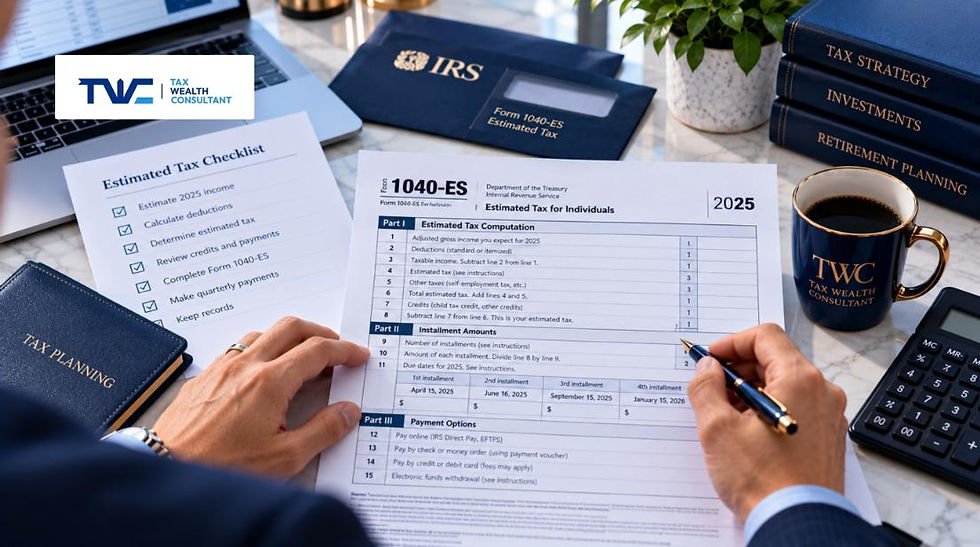
Estimated tax payments are payments made directly to the IRS throughout the year on income that has no tax withheld from it — self-employment earnings, interest, dividends, capital gains, rental income, and similar sources. The U.S. tax system operates on a pay-as-you-go basis under Internal Revenue Code Section 6654: tax is meant to be paid as income is received, whether through payroll withholding or through estimated payments, not accumulated and settled in a single payment at filing time. Individuals calculate and submit these payments using Form 1040-ES, and the periods are commonly called "quarterly," though per taxpayer advocacy reporting to Congress, the four periods are not actually evenly spaced three-month intervals — the second period runs only two months, and the fourth runs four.
Do I Have to Make Estimated Tax Payments?
🖼 IMAGE — 3 of 6 Midjourney prompt: Luxury premium financial photograph, hands reviewing an eligibility checklist against a withholding statement, deep navy and blue lighting, clean white desk surface, precise analytical composition, no visible face, photorealistic --ar 16:9 Filename: estimated-tax-payments-1000-dollar-threshold-irvine-ca.jpg Alt text: |

Per the IRS, individuals — including sole proprietors, partners, and S corporation shareholders — generally must make estimated tax payments if they expect to owe at least $1,000 in tax for the year, a threshold set well below most self-employment profit levels after subtracting withholding and refundable credits. Corporations generally face the same requirement at a $500 threshold, well below the $1,000 figure that applies to individuals. Common situations requiring estimated payments include self-employment income from a Schedule C business, a side business, significant investment income with no withholding, rental income, and alimony from agreements predating 2019 tax law changes. A taxpayer is generally excused from the requirement if they owed no tax at all in the prior year, were a U.S. citizen or resident for the entire prior year, and that prior year covered a full 12 months — though W-2 employees whose withholding fully covers their liability typically have no separate obligation to make estimated payments at all.
What Happens If You Miss a Quarterly Estimated Tax Payment?

Missing or shorting a quarterly payment triggers an underpayment penalty calculated on IRS Form 2210, assessed period by period rather than just against the year's total. This penalty functions as an interest charge rather than a flat fine, calculated on the shortfall for the specific number of days it remained unpaid, using a rate the IRS sets and adjusts quarterly. A penalty can apply even in a year where a self-employment taxpayer is ultimately due a refund when the full return is filed, because the penalty looks at whether each period's payment was adequate at the time it was due, not just the final annual outcome. Catching up a missed payment in a later quarter reduces the penalty going forward but does not erase the interest already accrued on the period that was short.
Not sure whether you're required to make estimated payments, or worried about a missed one?
Schedule a confidential 30-minute consultation with Tax Wealth Consultant.
taxwealthconsultant.com | (949) 409-8335
The 2026 Payment Schedule

For the 2026 tax year, the four payment deadlines fall on April 15, June 15, September 15, and January 15, 2027. Each period's payment is calculated on the income actually earned through that point, or on a proportional share of the annualized estimate for the year, and payments can be made online through IRS Direct Pay, by phone, by mail with a Form 1040-ES voucher, or through the Electronic Federal Tax Payment System. Paying even a partial amount by each deadline reduces the eventual penalty compared to paying nothing at all, so a taxpayer who cannot cover a full quarter's estimate is still better off submitting what they can rather than waiting until the next deadline.
Calculating the Right Amount — Where Most Mistakes Happen

Most people use one of two methods: paying a percentage of the prior year's tax liability, or estimating the current year's income directly and annualizing it. The prior-year method is simpler but can lead to significant over- or under-payment in a year where income changes meaningfully — a problem that gets considerably more specific once income crosses certain thresholds, where the IRS requires a higher percentage of the prior year's tax rather than the standard amount. We cover that stricter safe harbor math, along with California's separate and even stricter version, in our dedicated guide to estimated quarterly taxes for high earners. For most taxpayers below that threshold, the basic rules above cover the full picture.
How Tax Wealth Consultant Approaches Estimated Tax Planning
Tax Wealth Consultant confirms whether a client genuinely needs to make estimated payments in the first place, calculates each quarter's payment against actual income rather than a rough guess, and catches a missed or short payment early enough to limit the accruing penalty. Estimated tax planning is one of the simplest areas of the tax code to get right once someone is actually watching the calendar — and one of the most expensive to get wrong by accident.
Pay-as-you-go only works if someone is tracking the calendar for you.
Schedule your confidential 30-minute review with Tax Wealth Consultant today.
taxwealthconsultant.com | (949) 409-8335
Tax Wealth Consultant provides tax planning, tax preparation, and wealth advisory services for business owners, professionals, and investors in Irvine, Orange County, and beyond.


Comments