
IOLTA 3-Way Reconciliation Explained — What California Law Firms Must Do for CTAPP and Rule 1.15 Compliance
- Tax Wealth Consultant

- Jun 29
- 9 min read

For a California law firm, few financial tasks carry as much weight as the monthly IOLTA 3-way reconciliation. It is the process that proves the money in the firm's trust account actually matches the records of what the firm is holding for each client — and the State Bar takes it seriously enough to ask for proof at any time. Yet many firms either skip it, do it incorrectly, or assume that reconciling the bank statement alone is enough. It is not. A proper IOLTA reconciliation ties three separate records together, and getting it right is both an ethics obligation and, as we will explain, a quiet driver of whether the firm's taxes are correct.
This article explains what an IOLTA 3-way reconciliation is, the three data points that must agree, the components of the report, and the California rules behind it — CTAPP and Rule 1.15. A proper trust account reconciliation is more than a bank check, and understanding the full trust account reconciliation process is what keeps a firm compliant. It also explains a connection most firms overlook: the same clean trust accounting that keeps you compliant with the State Bar is what keeps your income and advanced-cost figures accurate for tax. As a tax planning firm Irvine attorneys turn to, we see firms struggle with this often. The facts here come from California's public trust accounting rules, and this is general education, not legal or ethics advice for your firm. If you run a practice and have been looking for a tax advisor near me or a tax planning firm Irvine attorneys trust who understands both attorney trust account compliance and the tax side, the points below show why those two things belong together.
What an IOLTA 3-Way Reconciliation Actually Is?

A 3-way reconciliation is a monthly check that confirms three separate records all agree with one another. The name comes from the three sources being compared. If all three match, the firm has strong evidence that every dollar of client money is accounted for. If they do not match, something is wrong — and that mismatch is exactly what the State Bar, and the firm itself, needs to catch early.
THE THREE DATA POINTS THAT MUST AGREE
The trust bank balance — the balance shown on the IOLTA account bank statement
The trust liability balance in the firm's books — the amount the firm's accounting records show it is holding in trust
The total of all client ledgers — the sum of every individual client's trust balance, showing exactly whose money makes up the account
The logic is simple but powerful: the money in the bank, the liability on the books, and the sum of what is owed to each client should all be the same number. When those three figures agree, the firm can prove that the IOLTA account holds precisely what it should — no more, no less. When they disagree, it signals a potential overage, shortage, or commingling problem that must be investigated. This is why a trust account reconciliation is fundamentally different from balancing a normal business bank account: it is not just confirming the bank's math, it is proving whose money is in the account.
The Three Records Behind the Reconciliation
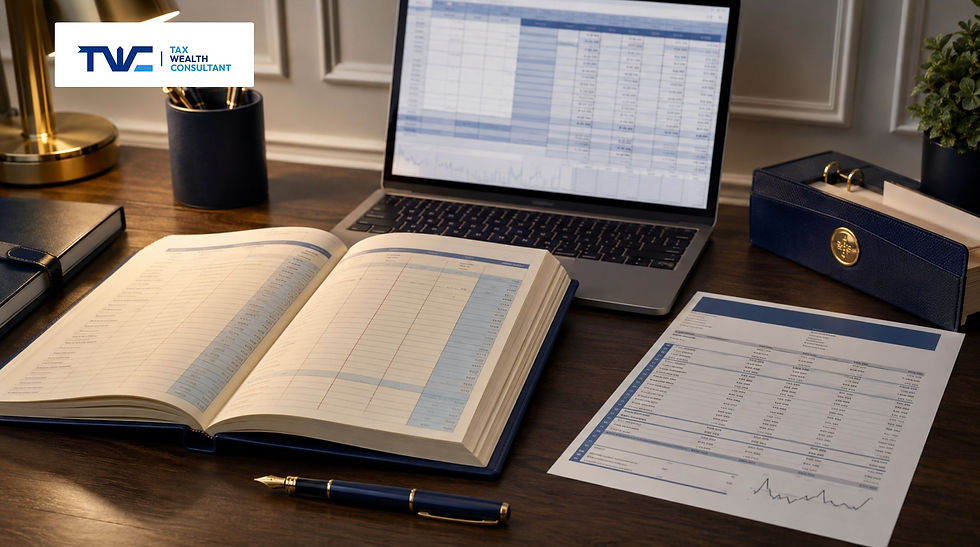
To perform an IOLTA 3-way reconciliation, a firm needs three well-maintained records. Each one plays a distinct role, and the reconciliation is only as reliable as the weakest of the three
THE COMPONENTS
The trust account journal — a running record of every deposit, disbursement, and transfer affecting the IOLTA account; it is the activity log that supports the monthly reconciliation
Individual client trust ledgers — a separate ledger for each client or matter showing every dollar in and out, so the firm can prove how much of the pooled balance belongs to whom
The firm's bookkeeping records — the trust-related liability balances in the firm's books, which must agree with the trust activity and the client-level balances
In many firms, the individual client ledgers originate in practice management software such as Clio, MyCase, Casepeer, or FileVine, while the bookkeeping records live in the firm's accounting system. The reconciliation is where those worlds are brought together and confirmed to match the bank. A firm that keeps a clean trust account journal and accurate per-client ledgers, and ties both to its books each month, has the foundation for a defensible reconciliation. A firm missing any one of the three cannot truly complete the process.
Why Monthly — and Why a Bank Reconciliation Alone Is Not Enough

A common and costly misunderstanding is that reconciling the IOLTA bank statement is sufficient. It is not. A standard bank reconciliation only confirms that the firm's record of the account matches the bank's record of the account. It says nothing about whether the money is correctly allocated among clients — and that allocation is the entire point of trust accounting.
WHY THE FULL 3-WAY PROCESS MATTERS
A bank reconciliation ties two records together; a 3-way reconciliation ties three, adding the critical client-ledger layer
Only the client-ledger total proves the firm is not holding one client's money to cover another's — the definition of a shortage or commingling
For California firms, performing the reconciliation monthly is the standard for keeping trust records accurate and current
Doing it monthly catches small errors before they compound into large, hard-to-trace discrepancies
The monthly cadence is not busywork. Trust errors are far easier to find and fix in the month they occur than a year later, when the underlying transactions are cold and the records may be incomplete. A firm that reconciles every month keeps a clean, continuous trail; a firm that waits often faces an expensive cleanup project just to rebuild what monthly discipline would have preserved. This is also why catching up a neglected trust account is a real project in itself — the IOLTA reconciliation has to be rebuilt month by month from the available records.
The California Rules Behind It: CTAPP and Rule 1.15

California law firms do not perform 3-way reconciliations as a matter of preference — they are tied to the State Bar's trust accounting requirements. Two terms every California attorney should know are Rule 1.15 and CTAPP.
WHAT THE RULES REQUIRE
Rule 1.15 of the California Rules of Professional Conduct governs funds a firm holds for clients and others; the current version was amended effective January 1, 2023, and carries recordkeeping duties that older summaries miss
The rules call for a trust account journal, individual client ledgers, and reconciliations that prove those records match the bank statement
CTAPP — the California Client Trust Account Protection Program — is the State Bar program under which firms must be able to demonstrate trust account compliance, and the State Bar can request proof
California's IOLTA framework sits within Business and Professions Code sections 6210 through 6228
The practical takeaway is that a California firm should expect to show, on request, a complete trust account journal, individual client ledgers documenting every dollar in and out per matter, and monthly three-way reconciliations with support for items like outstanding checks and deposits. Being able to produce those records without a scramble is the difference between a routine inquiry and a stressful one. Because the specific duties and deadlines are detailed and can change, the State Bar and a qualified professional are the right sources for a firm's exact obligations — this article is general education, not legal or ethics advice.
Recordkeeping: Retention and Where the Numbers Come From

A reconciliation is only useful if the records behind it are preserved and well-sourced. Two practical points matter here: how long records must be kept, and where the client-level data comes from.
RECORDKEEPING ESSENTIALS
Trust records generally must be retained for at least five years after the funds are disbursed — the reconciliation workpapers, journals, and client ledgers are part of that retained record
Client trust ledger data frequently comes from practice management systems (Clio, MyCase, Casepeer, FileVine), which track funds by matter
Those client-level balances must be confirmed against both the firm's books and the IOLTA bank statement — the heart of the 3-way process
Discrepancies such as uncleared checks, unrecorded deposits, or balance mismatches should be identified, corrected, and documented each cycle
The reason retention and sourcing matter is simple: if the State Bar asks for proof of a reconciliation from two years ago, the firm needs the journal, the client ledgers, and the supporting bank records for that period — not just a current snapshot. A disciplined monthly process, with each cycle's workpapers preserved, is what makes that possible. A firm that treats trust recordkeeping casually may find that the records simply are not there when they are needed most.
The Overlooked Tax Connection

Here is the part most discussions of 3-way reconciliation leave out — and it is where the trust compliance world meets the tax world. Clean trust accounting is not only about satisfying the State Bar. It is also what keeps a law firm's income and expense figures correct for tax purposes. The same client ledgers and trust liability balances that prove compliance are the records that determine when money becomes the firm's taxable income and how advanced client costs are handled.
WHY RECONCILIATION FEEDS ACCURATE TAXES
Money sitting in the IOLTA account is a client liability, not firm income — a clean reconciliation keeps that distinction accurate so the firm does not overstate income
A fee becomes the firm's income when it is earned and moved out of trust; the trust journal and ledgers are what pinpoint that timing
Advanced client costs that flow through the trust account must be tracked so they are not mistakenly treated as deductible expenses or as income when reimbursed
When trust records are messy, the numbers that flow into the tax return are unreliable — creating both compliance risk and tax risk at the same time
This is the connection that makes trust reconciliation a tax issue, not just a bookkeeping chore. A firm whose IOLTA reconciliation is clean has accurate, trustworthy numbers feeding its tax return; a firm whose trust records are a mess is almost certainly misstating something on its taxes too. That is also why we treat law firm bookkeeping, trust reconciliation, tax preparation, and tax planning as one connected system rather than separate services — because for a law firm, they truly are. (For the broader picture of why law firm books and taxes are uniquely complex, see our related article below.)
What This Guide Does Not Cover
This article is general education about how an IOLTA 3-way reconciliation works and the California rules behind it. It is not legal, ethics, or tax advice for your firm, and it does not cover: (1) your firm's exact obligations under Rule 1.15 and CTAPP, which can change and depend on your circumstances — the State Bar is the authoritative source; (2) the detailed setup and operation of your specific bookkeeping or practice management software; (3) the precise tax treatment of a particular fee, settlement, or advanced-cost situation, which depends on your facts and accounting method; (4) any matter requiring a licensed attorney's judgment on the trust accounting rules themselves. Each of these requires individual analysis with the appropriate professional.
Where to Go From Here

An IOLTA 3-way reconciliation is one of the clearest examples of why law firm finances cannot be handled casually. The three data points must agree every month, the California rules behind them are strict, the records must be preserved for years, and — the part many firms miss — the same clean trust accounting is what keeps the firm's taxes accurate. Get the reconciliation right, and you are protecting both your State Bar standing and your tax position at once. At Tax Wealth Consultant, a tax planning firm Irvine attorneys rely on, serving Orange County and California, we connect the trust-compliance side and the tax side, so your IOLTA reconciliation is clean, your income and advanced-cost figures are correct, and your tax planning is built on numbers you can trust. If you run a firm and have been searching for a tax advisor near me who understands attorney trust account compliance and taxes together, let us show you what that integration looks like.
Sources referenced in this article: • California Rules of Professional Conduct, Rule 1.15 (safekeeping funds and property of clients and others; amended effective January 1, 2023) • California Business and Professions Code sections 6210-6228 (IOLTA framework) • California Client Trust Account Protection Program (CTAPP), administered by the State Bar of California • IRS Publication 5602 — Attorneys Audit Technique Guide (treatment of trust accounts, advanced costs, and income includible to the attorney) This article is general education about IOLTA 3-way reconciliation; it is not legal, ethics, or tax advice for a specific firm. The State Bar of California is the authoritative source for trust accounting obligations. |
Clean Trust Books, Correct Taxes — Handled Together Body
Tax Wealth Consultant connects your IOLTA 3-way reconciliation to your tax picture, so your trust records satisfy the State Bar and your income and advanced-cost figures are correct for tax. One team that understands attorney trust account compliance and taxes — so nothing is misstated and nothing is a surprise.
Or call (949) 409-8335 — speak with a tax advisor near me in Irvine today
Or email support@taxwealthconsultant.com


Comments