
How Medical & Dental Practices Should Deduct Equipment — Section 179, Bonus Depreciation, and Timing


Medical and dental practices are among the most equipment-intensive businesses there are. Imaging machines, CBCT scanners, dental chairs, lasers, sterilization systems, and practice technology can each represent a major investment — and how a practice deducts those purchases has a large effect on its taxes. The tax code offers several ways to write off equipment, and the difference between them, and the timing of when you buy, can be worth a great deal. Used well, the Section 179 deduction and bonus depreciation can let a practice write off most or all of a big equipment purchase in the year it is placed in service. Used carelessly, a practice can leave real money on the table or run into limits it did not see coming.
This article explains the three ways a practice can deduct equipment, the order the IRS requires, how to time a purchase for maximum benefit, and the traps to watch — including the business-income limit and depreciation recapture. Whether you are weighing a dental equipment tax deduction or planning medical equipment depreciation on a new imaging system, the Section 179 medical practice rules below apply the same way. Every figure here is drawn from IRS sources and reflects 2026 amounts that can change. Good tax preparation reports these deductions, but only proactive planning positions them — and that distinction matters here. This is general education, not tax advice for your practice. If you are a practice owner who has searched for the Section 179 deduction, medical equipment depreciation, the right dental equipment tax deduction, how the Section 179 medical practice limits work, or a tax advisor near me who understands a practice's equipment decisions, the breakdown below is exactly what proactive planning looks like.
The Three Ways to Deduct Equipment

When a practice buys equipment, it generally has three ways to recover the cost for tax purposes. Understanding what each one does is the foundation of any equipment decision, because the right mix depends on the practice's profitability and goals.
Section 179 expensing: lets a practice elect to immediately deduct the full cost of qualifying equipment placed in service, up to $2,560,000 for tax years beginning in 2026, with the deduction phasing out dollar-for-dollar once total qualifying purchases exceed $4,090,000 (IRS Publication 946)
Bonus depreciation (the special depreciation allowance under IRC Section 168(k)): generally 100% for qualifying property placed in service after January 19, 2025 — with no dollar cap and no business-income limit
MACRS depreciation: the regular method, spreading the deduction over the asset's recovery period (often five or seven years for medical and dental equipment) when a practice prefers to defer deductions to future years
Most medical and dental equipment qualifies as tangible personal property eligible for all three methods
In practice, the Section 179 deduction and bonus depreciation are the two tools that allow large upfront write-offs, while MACRS is the slower, spread-out alternative. The choice between immediate expensing and spreading the cost is not automatic — it is a planning decision that should match the practice's tax situation, which is exactly why it pays to decide before year-end rather than at filing.
The Order Matters: Section 179, Then Bonus, Then MACRS

The IRS applies these deductions in a specific order, and understanding it explains how a practice can combine them on a single large purchase. The general sequence is Section 179 first, then bonus depreciation on any remaining basis, then MACRS on whatever is left (IRS Instructions for Form 4562).
Step 1: elect the Section 179 deduction first, up to the annual limit and subject to the business-income limit described below
Step 2: apply bonus depreciation to any remaining cost basis — at 100%, this can absorb the rest of most purchases
Step 3: depreciate any remaining basis under MACRS over the recovery period
Equipment is reported on Form 4562, and the deductions are claimed in the year the equipment is placed in service
For most practices buying typical equipment, the combination of Section 179 and 100% bonus depreciation can write off the entire cost in year one. But the order and the limits matter, because the two tools behave differently when a practice's income is low — which is the trap covered next.
The Business-Income Limit Trap on Section 179

Here is a key difference that trips up practices: the Section 179 deduction is limited to the practice's taxable business income, while bonus depreciation is not. This means Section 179 cannot, by itself, create or increase a loss — but bonus depreciation can.
Section 179 cannot exceed the net taxable income from the active conduct of the business; any disallowed amount carries forward to a future year (IRS Publication 946)
Bonus depreciation has no business-income limit and can create a net operating loss, which may be useful in a low-income year
So in a high-income year, a practice can often use Section 179 fully; in a low-income year, bonus depreciation may do more work
Matching the method to the year's income is the heart of equipment depreciation planning
Illustrative example (rounded, for explanation only): A practice has $150,000 of taxable income and buys $200,000 of qualifying equipment. Section 179 alone is capped at the $150,000 of business income, so it cannot deduct the full $200,000 by itself. By applying Section 179 up to the income limit and then bonus depreciation to the remaining basis, the practice can still write off the full purchase in year one — and bonus depreciation can even push the practice into a loss if that is advantageous. The point: the two tools work together, and which one leads depends on the practice's income. Your actual result depends on your specific situation. |
This is why a practice should not simply assume Section 179 will cover a big purchase. In the wrong income year, Section 179 alone falls short, and a practice that does not understand the interplay with bonus depreciation may defer deductions it could have taken now — or miss the chance to manage a loss strategically. Smart medical equipment depreciation planning is one of the most valuable tax deductions for doctors precisely because it is so often mishandled, and the available tax deductions for doctors here can be substantial when the method matches the year.
Timing Is a Strategy — and Financed Equipment Still Qualifies
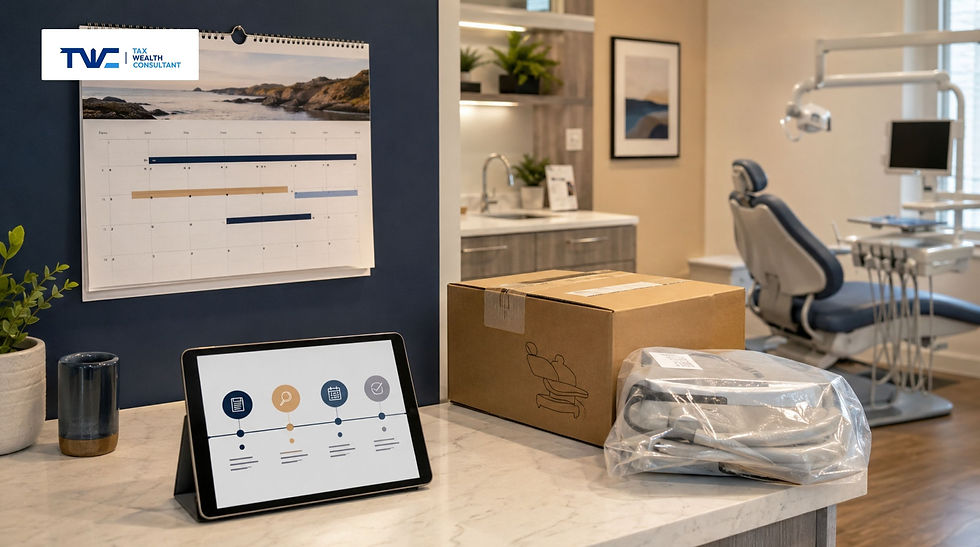
Two practical points make a real difference. First, the deduction lands in the year the equipment is placed in service — not when it is ordered or paid for — so the timing of a purchase is itself a planning lever. Second, equipment that is financed still qualifies for the deduction.
Placed in service means the equipment is ready and available for use — that date, not the purchase date, generally controls the deduction year
A practice expecting a high-income year can time an equipment purchase to place it in service in that year, so the deduction offsets income when it is most valuable
Financed equipment generally qualifies for Section 179 and bonus depreciation in full in the year placed in service, even though the practice pays for it over time — the deduction can exceed the cash paid that year
Equipment must generally be acquired from an unrelated party and used more than 50% for business to qualify for Section 179
The financing point is especially powerful for practices: a practice can place a large financed purchase in service, deduct most or all of it now, and pay for the equipment over several years — a meaningful cash-flow and tax advantage when planned deliberately. As always, the strategy should fit the practice's full tax picture rather than being driven by the deduction alone.
Two Cautions: State Conformity and Recapture

Before treating an equipment write-off as pure savings, two cautions deserve attention — and both are places where a generic approach can cause surprises.
State conformity: many states, including California, do not fully follow the federal Section 179 and bonus depreciation rules, so the state tax treatment can differ significantly from the federal — the deduction is often smaller for state purposes
Depreciation recapture: if a practice later sells the equipment or its business use drops, some of the previously claimed depreciation can be 'recaptured' and taxed, often as ordinary income
This means accelerated expensing is largely a timing benefit — deductions now, with potential recapture later if the asset is sold
A short holding period or an early sale can pull recapture forward, reducing the net benefit
None of this makes Section 179 or bonus depreciation a bad idea — for a practice that buys and keeps equipment it uses, the upfront deduction is genuinely valuable. But the state difference and the recapture rules mean the real, after-everything benefit should be modeled, not assumed. This is exactly the kind of detail a practice-focused professional accounts for and a generic preparer often overlooks.
An Important Note
Every practice's situation is different, and the rules above are general tax concepts, not personalized tax advice. As a tax planning firm Irvine practice owners work with, we tailor the approach to each practice. Among the tax deductions for doctors, equipment write-offs are some of the largest, but the right equipment-deduction strategy for you depends on your income, your purchases, your state, your holding plans, and your goals, and the figures cited are 2026 amounts that can change. State conformity and recapture in particular require analysis of your specific facts. The best results come from modeling the decision with a qualified professional before you buy — ideally before year-end, while the timing can still be planned.
Where to Go From Here

How a practice deducts its equipment is one of the most valuable — and most misunderstood — tax decisions a practice owner makes. The Section 179 deduction, bonus depreciation, and MACRS each play a role, the order and income limits matter, timing the placed-in-service date is a real lever, and state conformity and recapture can change the net result. Whether the question is a Section 179 medical practice decision on an imaging system or a dental equipment tax deduction on new operatory chairs, the same planning applies. Get it right, and a practice can recover the cost of major equipment exactly when it helps most. At Tax Wealth Consultant, a tax planning firm Irvine practice owners rely on, serving Orange County and California, we build equipment-deduction strategy into proactive medical practice tax planning, modeling Section 179, bonus depreciation, timing, state treatment, and recapture against your full tax picture — so your tax preparation reflects a plan, not a scramble. As a tax planning firm Irvine practices trust for both medical practice tax planning and accurate tax preparation, we connect the purchase to the return. If you are a practice owner searching for a tax advisor near me who understands how equipment decisions flow through to your taxes, let us help you plan the purchase before you make it.
Related:

Sources (tax figures are 2026 amounts and may change): • IRS Publication 946 — How To Depreciate Property (Section 179 limit $2,560,000; phase-out $4,090,000; business-income limitation; MACRS) • IRS Instructions for Form 4562 — Depreciation and Amortization (ordering of Section 179, bonus depreciation, MACRS) • Internal Revenue Code Section 179 — Election to expense certain depreciable assets • Internal Revenue Code Section 168(k) — Special depreciation allowance (bonus depreciation), generally 100% for property placed in service after January 19, 2025 • Depreciation recapture rules under the Internal Revenue Code Note: state treatment (including California) may differ from federal. This article is general education about deducting medical and dental equipment; it is not tax advice for a specific practice. |
Plan the Equipment Purchase Before You Make It
Tax Wealth Consultant models Section 179, bonus depreciation, timing, state treatment, and recapture against your practice's full tax picture — so a major equipment purchase delivers the biggest, best-timed deduction. Proactive medical practice tax planning, not an April surprise.
Or call (949) 409-8335 — speak with a tax advisor near me in Irvine today
Or email support@taxwealthconsultant.com


Comments