
The Spousal Lifetime Access Trust in 2026 — Removing Assets From Your Estate Without Fully Giving Up Access


The most common objection to lifetime gifting for estate tax purposes is straightforward: giving away significant assets means giving up access to them, permanently. The spousal lifetime access trust addresses this directly. It allows one spouse to remove substantial assets from their taxable estate while the other spouse remains a permitted beneficiary — preserving a real, practical connection to the wealth even after it has left the estate for tax purposes. Here is how a SLAT actually works, and the details that make or break it.
The Basic Structure

A spousal lifetime access trust is an irrevocable trust — meaning an irrevocable trust cannot be undone once funded — created and funded by one spouse — the donor spouse — for the benefit of the other spouse, often with children or grandchildren named as additional or remainder beneficiaries. The donor spouse gifts assets such as cash, marketable securities, business interests, or real estate into the trust, applying a portion of their lifetime federal gift and estate tax exemption to shield the transfer from gift tax. Once funded, the beneficiary spouse can request distributions of income or principal from the trust, which provides the donor spouse an indirect, practical benefit even though they have no direct rights to the trust assets themselves.
Because the donor spouse gives up all direct legal control and ownership, properly structured and administered SLAT assets are excluded from both the donor spouse's and the beneficiary spouse's taxable estates — along with all future appreciation and income the assets generate inside the trust, which compounds free of any additional estate or gift tax exposure.
The Grantor Trust Advantage

A SLAT is typically structured as a grantor trust for income tax purposes, which means the donor spouse — not the trust itself or the beneficiaries — remains personally responsible for paying income tax on all income the trust generates, whether or not that income is distributed. Under current law, this arrangement does not create an additional taxable gift, even though the donor spouse is effectively paying tax on behalf of the trust's beneficiaries every year. The practical effect is that the trust's assets grow without being diminished by their own tax liability, functioning as a further, ongoing transfer of wealth outside the normal gift tax system.
The Reciprocal Trust Trap
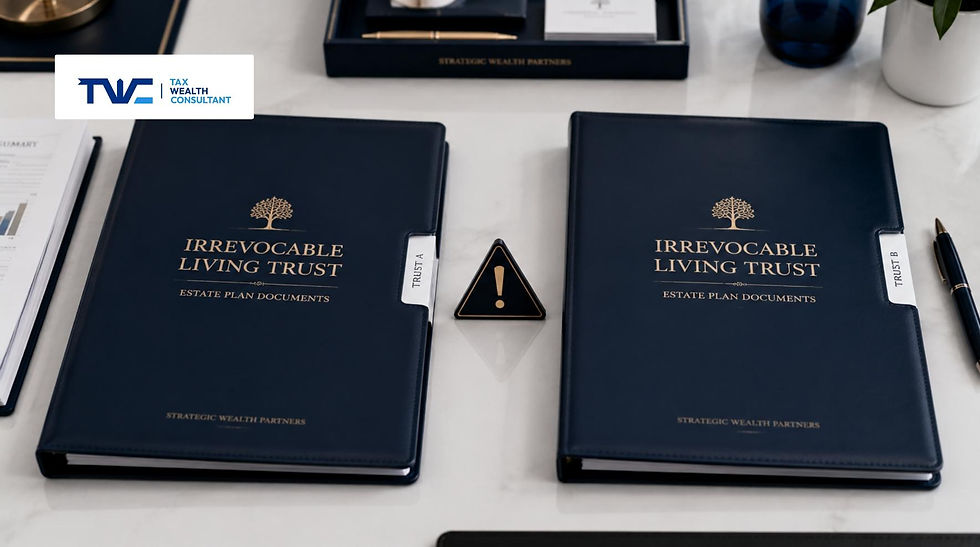
A frequent strategy is for both spouses to create their own SLAT for the benefit of the other, doubling the total amount of gift and estate tax exemption applied. This creates a genuine trap: if the two trusts are structured too similarly — comparable funding amounts, similar terms, overlapping trustees, near-simultaneous creation dates — the IRS can invoke the reciprocal trust doctrine and effectively uncross the trusts, treating each spouse as the beneficiary of their own trust rather than their spouse's, unwinding the intended estate tax benefit entirely. Avoiding this outcome requires deliberately varying the trusts: different funding amounts, different distribution standards, different trustees, and meaningful time gaps between when each trust is created and funded.
Considering a SLAT, or a pair of SLATs with your spouse?
The reciprocal trust rules require careful structuring from day one. Schedule a consultation.
taxwealthconsultant.com | (949) 409-8335
The Real Risk — Divorce and Death

This is the honest fact that belongs at the center of any SLAT conversation: the donor spouse's indirect access to the trust runs entirely through the beneficiary spouse. If the beneficiary spouse dies first, or if the couple divorces, that indirect access disappears — the trust does not revert to the donor spouse, and depending on the trust's terms, a former spouse may need to be removed as a beneficiary going forward or may retain rights the donor spouse never anticipated. Because the transfer into an irrevocable trust is permanent, this risk cannot be undone after the fact; it has to be weighed honestly before funding the trust, not discovered afterward.
Who a SLAT Genuinely Fits

A SLAT is most appropriate for married couples with a stable relationship and assets substantial enough that a meaningful portion of their combined estate would otherwise face federal estate tax — a lifetime exemption in the eight figures per person under current law means this strategy is generally reserved for genuinely high-net-worth families. It fits particularly well in periods when the exemption amount is historically high but scheduled to decrease, since funding a SLAT locks in the higher exemption for the gifted assets regardless of what happens to the exemption later. It is a poor fit for couples who may need the gifted assets back directly, and it should never be undertaken with any expectation about the future stability of the marriage — the assets, and the indirect benefit they provide, ride entirely on that relationship.
How Tax Wealth Consultant Approaches SLAT Planning
Tax Wealth Consultant does not draft trust documents — that belongs with your estate planning attorney — but as part of coordinated estate planning we help model whether a SLAT, or a properly differentiated pair of SLATs, fits your family's overall wealth transfer goals, evaluate the income tax consequences of the grantor trust structure, and coordinate the funding decision with the rest of your estate and tax plan. A strategy this dependent on the details of drafting and the realities of family circumstances deserves real conversation before assets are irrevocably transferred.
Estate tax exemption is historically high right now. It will not stay that way indefinitely.
Schedule your confidential 30-minute review with Tax Wealth Consultant today.
taxwealthconsultant.com | (949) 409-8335


Comments