
Selling a Rental Property — Why Waiting Past 12 Months (and Using a 1031 Exchange) Changes Everything


Your rental property has appreciated significantly. Maybe it doubled in value. Maybe it tripled. The Orange County and Southern California real estate market has handed some investors gains of $300,000, $500,000, or more on a single property bought just a few years ago. And now you are thinking about selling.
Before you call your real estate agent, there are three things an Enrolled Agent Irvine needs to walk you through: how your rental property capital gains will be taxed, why your timing decision matters enormously, and whether a 1031 exchange rental property strategy eliminates the tax bill entirely. Getting this right before you list the property can save you six figures. Getting it wrong costs the same.
At Tax Wealth Consultant, a tax planning firm serving real estate investors in Irvine, Whittier, and Orange County, we model these decisions for clients every quarter. This guide walks through the complete picture — from the sell-rental-property taxes mechanics to the 1031 exchange rental property exit that most investors underutilize.
What Actually Happens When You Sell a Rental Property — The Four Tax Components

Selling a rental property is not one tax event. It is four tax events happening at once, each taxed differently. Most investors know about capital gains. Most do not know about the other three until they see the tax bill.
1. Long-Term Capital Gains on Appreciation
If you held the property more than 12 months, the appreciation above your adjusted cost basis is taxed as long-term rental property capital gains — at federal rates of 0%, 15%, or 20% depending on your income. This is the real estate capital gains tax 2026 rate that most people are thinking of when they ask "how much will I owe when I sell?" It is real and significant, but it is not the only tax.
2. Depreciation Recapture (the one most investors forget)
Every year you own a rental property, the IRS allows you to deduct depreciation — 27.5 years for residential real estate. That is a real annual tax benefit while you hold the property. But when you sell, the IRS takes it back. Every dollar of depreciation you claimed over the years gets "recaptured" and taxed at a special rate of up to 25%. This is called Section 1250 depreciation recapture, and it applies regardless of whether your overall gain is short-term or long-term. Depreciation recapture is the most expensive surprise in real estate investor tax planning.
Depreciation Recapture Example You bought a $400,000 rental property in 2018, allocating $320,000 to the building (land does not depreciate). Over 7 years, you claimed approximately $81,454 in depreciation ($320,000 / 27.5 x 7). You sell in 2026 for $700,000. That $81,454 of depreciation is taxed first at up to 25% — about $20,363 in federal tax — before any long-term capital gains rate applies to the remaining appreciation. A tax planning firm models this separately from the capital gain calculation. |
3. Net Investment Income Tax (NIIT)
High-income investors pay an additional 3.8% NIIT on real estate capital gains if modified adjusted gross income exceeds $200,000 (single) or $250,000 (married filing jointly). For a real estate investor in Orange County with significant other income, NIIT applies on top of the 20% long-term rate — bringing the effective federal rate to 23.8% on the capital gain portion.
4. California State Tax
California taxes all capital gains — short-term and long-term — as ordinary income at rates up to 13.3%. Unlike the federal government, California does not offer a preferential long-term capital gains rate. For a California-based real estate investor, sell rental property taxes carry a combined federal-plus-state marginal rate on appreciation that can approach 37% to 40%.
The Full Tax Picture on a $400,000 Rental Property Gain Federal long-term capital gains (20%) + NIIT (3.8%) + Depreciation recapture (25% on recaptured amount) + California state (13.3%) — combined, the total tax on selling a highly appreciated California rental property at the top brackets can consume 37% to 42% of the gain. Real estate investor tax planning is not about avoiding these taxes — it is about knowing which tools exist to defer, reduce, or eliminate them before you sell. |
Why Selling Within 12 Months Is Almost Always the Wrong Move
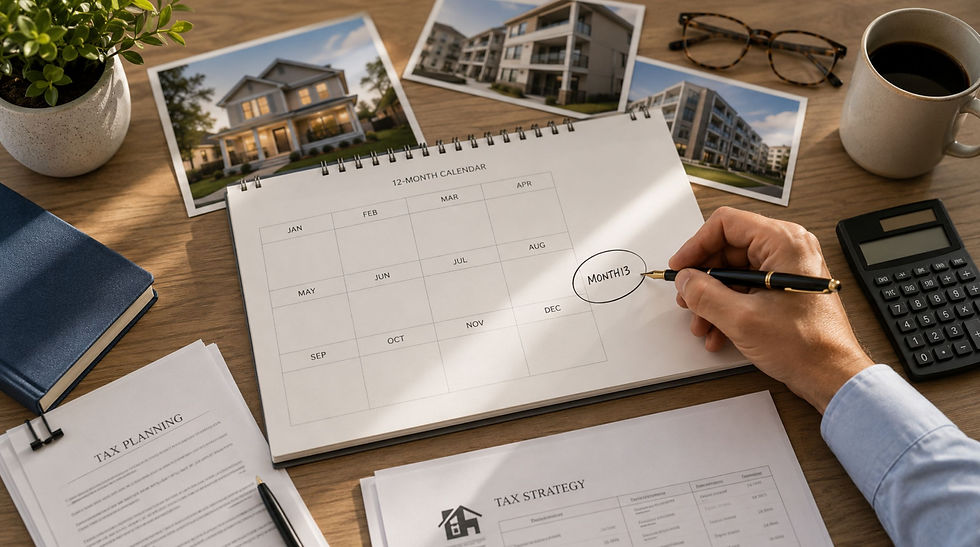
A landlord buys a rental home in Irvine in early 2025 for $800,000. By late 2025, it has appreciated to $1,000,000 — a $200,000 gain in under a year, driven by the Orange County market. Tempting. They consider selling at month 10.
That is a short-term capital gains rental property outcome. The $200,000 gain would be taxed as ordinary income at the federal level — up to 37% — instead of the 20% long-term rate. Here is what that costs at the top bracket:
Tax Component | Sell at Month 10 (Short-Term) | Sell at Month 13 (Long-Term) | |
$200,000 Capital Gain |
|
| |
Federal Rate | 37% (ordinary income) | 20% (long-term) | |
Federal Tax on Gain | $74,000 | $40,000 | |
NIIT (3.8%) | $7,600 | $7,600 | |
California (13.3%) | $26,600 | $26,600 | |
Total Tax Bill | $108,200 | $74,200 | |
DIFFERENCE | — | $34,000 saved by waiting 3 months |
Waiting three months saves $34,000 on a $200,000 gain. On a $500,000 gain at the same brackets, the savings from crossing the 12-month line approach $85,000 in federal tax alone. For any real estate investor tax planning around an appreciated property, the first question an Enrolled Agent Irvine asks is: where are you in the holding period?
The short-term capital gains rental property trap is most common with investors who bought in a hot market and saw rapid appreciation — exactly the Orange County and Southern California market dynamic of the last several years. The instinct to sell into a strong market is understandable. The tax cost of selling at month 10 versus month 13 is not.
Depreciation Recapture — The Hidden Cost Most Investors Miss

Depreciation recapture is the most misunderstood component of sell rental property taxes. It applies regardless of the holding period — long-term or short-term. And it applies even if you forgot to take the depreciation deduction on your tax returns over the years. The IRS taxes depreciation you were allowed to take, not just what you actually claimed.
The math is straightforward but the impact is not always visible until the return is prepared. For every year of a residential rental property held, the annual depreciation deduction is the building value divided by 27.5. A $500,000 building generates roughly $18,182 in annual depreciation. Hold the property for 10 years and you have claimed (or should have claimed) approximately $181,820 in depreciation — all of which is subject to 25% Section 1250 depreciation recapture on sale, regardless of your long-term capital gains rate.
Depreciation Recapture Rule of Thumb For every $100,000 of depreciation claimed on a residential rental property, the depreciation recapture tax owed at sale is approximately $25,000 in federal tax alone — before California state tax at up to 13.3%. A 10-year hold on a $600,000 building generates roughly $218,182 in depreciation, and approximately $54,545 in federal recapture tax on sale. Real estate investor tax planning accounts for this in every pre-sale analysis. |
The only tool in the tax code that fully eliminates depreciation recapture — not defers, but eliminates — is the step-up in basis at death. The only tool that fully defers it during your lifetime is the 1031 exchange rental property strategy. Which brings us to the most important section of this guide.

The 1031 Exchange — How to Sell a Rental Property and Pay Zero Tax on the Gain

A 1031 exchange rental property transaction is the most powerful tool available to real estate investors for deferring rental property capital gains and depreciation recapture on a sale. Under Section 1031 of the Internal Revenue Code, a real estate investor can sell one investment property and acquire another like-kind investment property — deferring ALL capital gains tax and ALL depreciation recapture to a future date.
"Deferring" is not the same as "eliminating" — but with proper real estate investor tax planning, that deferred tax may never be paid. An investor who completes 1031 exchange rental property transactions repeatedly across a lifetime and holds until death passes the property to heirs with a step-up in basis, eliminating the deferred tax permanently. We cover this strategy in detail in our companion guide.
How a 1031 Exchange Rental Property Works — The Basics
You sell your rental property. Instead of receiving the proceeds, a Qualified Intermediary (QI) holds them in escrow.
Within 45 days of closing on the sold property, you identify up to three replacement properties in writing.
Within 180 days, you close on the replacement property. The QI transfers the funds directly — you never touch the money.
Your capital gains tax and depreciation recapture are deferred. Your cost basis in the new property is reduced by the deferred gain.
You continue owning investment real estate — at a higher value, with no tax bill paid, and with the deferred gain riding inside the new property until a future sale or death.
1031 Exchange on the $400,000 Gain Example Same investor from earlier — $400,000 appreciation, $81,454 depreciation recapture at stake, $700,000 sale price. Without a 1031 exchange: total tax bill at top brackets (federal + NIIT + recapture + California) approaches $160,000 to $180,000. With a 1031 exchange into a like-kind replacement property of equal or greater value: $0 tax due at the time of sale. The full $700,000 of sale proceeds roll into the next property. That $160,000 of capital that would have gone to the IRS stays invested and compounding. |
What Qualifies for a 1031 Exchange
Almost any U.S. investment real estate qualifies as like-kind to almost any other U.S. investment real estate. A single-family rental can be exchanged for a small apartment building. An apartment building can be exchanged for commercial property. Vacant land held for investment can be exchanged for a rental home. The IRS like-kind standard is broad — the property just has to be held for investment or productive use in a trade or business, not for personal use or resale.
Your primary residence does not qualify. A fix-and-flip property held primarily for resale does not qualify. A vacation home you use personally does not qualify unless it meets the 1031 vacation home safe harbor. For anything else — if it is a rental producing income or held for appreciation — it almost certainly qualifies for a 1031 exchange rental property deferral.
For the complete rules on identification deadlines, qualified intermediaries, boot, debt matching, and the most common pitfalls, read our full 1031 exchange guide:
Sell Now, Wait Past 12 Months, or Do a 1031 Exchange — How to Decide

Every real estate investor in this situation faces the same three-way decision. Here is how Tax Wealth Consultant's Enrolled Agent Irvine advisors frame it for clients:
Sell Now (short-term) — when it makes sense
The investment is deteriorating — structural issues, problem tenants, declining neighborhood — and the cost of holding outweighs the tax savings from waiting.
You need liquidity urgently and no financing alternative exists. Paying short-term capital gains rental property tax is sometimes the right business decision.
Your income is low enough this year that short-term vs. long-term rates are not meaningfully different. A taxpayer in the 12% bracket owes 0% on long-term capital gains regardless.
Wait Past 12 Months — when it makes sense
You are within 60 to 90 days of the 12-month line. The tax savings from crossing from short-term to long-term capital gains rental property treatment are real and computable.
The property is stable or still appreciating. Holding a performing asset an extra quarter to save $30,000 to $80,000 in tax is almost always worth it.
You are in a high income bracket where the gap between short-term capital gains rental property rates and long-term capital gains rates is 15 to 17 percentage points.
You plan to sell outright — not exchange. If you plan to reinvest in real estate, the 1031 exchange strategy dominates.
1031 Exchange — when it makes sense
You want to reinvest in real estate — whether a larger property, a different market, a passive DST interest, or a more cash-flowing asset class.
Your rental property capital gains and depreciation recapture combined exceed $100,000. Below that, exchange costs and complexity may not be worth it. Above that, the savings almost always justify it.
You are building a long-term real estate portfolio. Each exchange preserves full capital for reinvestment — no tax drag compounding against your returns over decades.
You are approaching retirement and plan to hold until death — the swap-till-you-drop strategy that eliminates deferred tax through the step-up in basis at death. This is real estate investor tax planning at its most powerful.
A Note for California Real Estate Investors — The State Tax Reality
California's treatment of real estate capital gains tax 2026 is worth its own section because it changes the sell-or-hold calculus in ways that surprise investors from other states.
California taxes ALL capital gains as ordinary income — no preferential long-term rate. The 13.3% top marginal rate applies to your rental property capital gains the same as your wages.
California does NOT conform to the 1031 exchange clawback rules in some cases — if you complete a 1031 exchange rental property transaction and later sell the replacement property in a non-1031 year from outside California, the FTB may still assert California tax on the original deferred gain. Real estate investor tax planning that crosses state lines needs Enrolled Agent Irvine guidance on California FTB compliance.
California has no estate tax — which makes the step-up in basis at death even more powerful for California investors than in states with their own estate tax.
The bottom line: for a California-based investor, the combined sell rental property taxes at the top bracket — federal capital gains + NIIT + depreciation recapture + California — can consume 38 to 42 cents of every dollar of gain. That is the number that makes the 1031 exchange rental property strategy so compelling in this market.
How Tax Wealth Consultant Handles Rental Property Sale Analysis

As an Enrolled Agent tax planning firm in Irvine and Whittier serving Orange County and Southern California, Tax Wealth Consultant runs pre-sale analysis for real estate investor clients before any listing goes live. Our process:
Calculate the adjusted cost basis — original purchase price, plus capital improvements, minus all depreciation claimed over the hold period
Model the depreciation recapture tax separately from the capital gains tax — many investors do not know these are taxed at different rates
Run the full real estate capital gains tax 2026 calculation including federal long-term rate, NIIT, depreciation recapture at 25%, and California state tax at 13.3%
Compare sell-outright vs. 1031 exchange rental property — model both scenarios with actual numbers so you can see the dollar difference before you decide
Identify the holding period position — if you are within 60 to 90 days of the 12-month line, we quantify exactly what waiting is worth
Coordinate with your real estate attorney and QI on 1031 exchange structure if the exchange path makes sense
This analysis takes one session. For a property with $200,000 or more in appreciation, the session is worth thousands of dollars in tax savings — often tens of thousands. We do not charge for estimates. We charge for the full plan, and the plan pays for itself.
For the fundamentals of how the short-term vs. long-term capital gains decision works across all asset classes — not just real estate — read our companion guide:
If you own a rental property in Orange County or Southern California that has appreciated significantly, the time to have this conversation is before you list — not after the offer comes in. Tax Wealth Consultant's Enrolled Agent advisors provide real estate investor tax planning that goes beyond the return.
Thinking About Selling Your Rental Property? Run the Numbers First.
Schedule a 30-minute strategy call with Tax Wealth Consultant. We will calculate your rental property capital gains, depreciation recapture, and total tax exposure — then model the 1031 exchange alternative side by side. You will walk away with a clear written comparison showing what you keep under each scenario. Not a sales pitch — a real analysis.
Or call (949) 409-8335 — speak with an Enrolled Agent Irvine today.


Comments