
How to Title Real Estate in 2026 — Trust, LLC, or Personal Name?


Real estate is usually the largest asset on a family balance sheet, and how it is titled quietly determines who can be sued over it, how easily heirs receive it, and how much of it survives probate. There is no single correct answer — a personal residence, a rental property, and a vacation home each call for different treatment, and the right structure depends on liability exposure, estate planning goals, and simple practicality. Here is how a trust, an LLC, and personal ownership actually compare for 2026.
Personal Name — Simple, but Fully Exposed

Holding property directly in your own name is the default, the simplest to set up, and it requires no ongoing formalities or filings. It is also the most exposed structure available: if a claim arises from an incident on the property, your personal assets beyond that property are on the table, and at death the property generally must pass through probate before an heir receives clear title — a public, often lengthy, and potentially costly court process. For most homeowners the personal residence sits here by default until an estate plan is put in place, but for rental or investment property, personal ownership is generally the weakest choice available.
The Revocable Living Trust — Built for Your Personal Residence

For a primary residence, second home, or vacation property that does not generate significant liability risk, a revocable living trust is generally the recommended structure. Placing the home in the trust does not change how you use it — you continue living there and managing it exactly as before, typically as the trustee — but at your death, the successor trustee can transfer the property directly to your beneficiaries without probate court involvement. This is particularly valuable if you own property in more than one state, since each state's probate process would otherwise need to be navigated separately.
One honest limitation: a revocable trust provides no liability shield. Because you retain full control and the ability to revoke it at any time, the law does not treat trust assets as separate from you for creditor purposes the way it treats a properly maintained LLC. The trust solves for probate and incapacity planning; it does not solve for lawsuit exposure.
The LLC — Built for Rental and Investment Property

For rental and investment property, the calculation flips. Real property generates real liability risk — a slip and fall, a tenant dispute, an environmental issue — and a limited liability company is the structure built specifically to contain that risk to the property itself rather than exposing your personal assets. Many investors title each property in its own single-purpose LLC, so a claim against one property cannot reach the others or the owner's personal wealth.
For federal tax purposes, a single-member LLC is typically treated as a disregarded entity — the rental income and expenses flow straight onto your personal return exactly as if you owned the property directly, with no separate LLC tax return required. The liability protection exists at the state law level, not as a change in how the IRS taxes the income. An LLC interest, however, is personal property that must still be transferred into a trust or otherwise addressed in your estate plan, or it too will face probate at death.
Different properties, different risks — is each one titled the right way?
Schedule a confidential 30-minute consultation with Tax Wealth Consultant.
taxwealthconsultant.com | (949) 409-8335
The Hybrid Approach — Both Structures Working Together
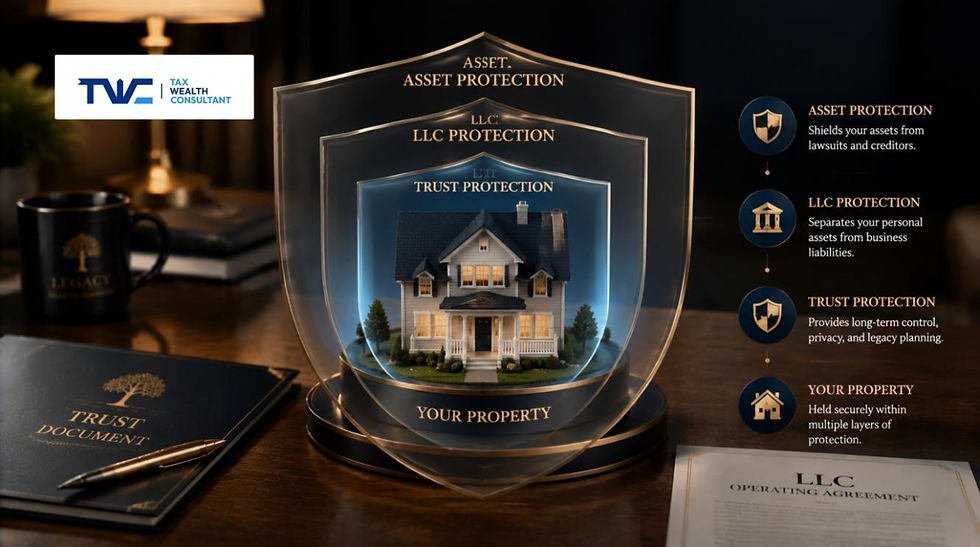
Sophisticated real estate holders frequently combine both tools: the LLC holds title to the property and absorbs the liability, while the revocable trust owns the membership interest in the LLC. This layered structure delivers the LLC's liability containment for the property itself, together with the trust's probate avoidance and privacy for the ownership interest — the best features of each structure applied where they actually work best. It requires more setup and more careful maintenance of formalities than either tool alone, but for an investor with multiple properties it is frequently the strongest combination available.
The Common Mistake — Titling and Forgetting

The most common failure with any of these structures is not choosing the wrong one — it is setting it up once and never revisiting it. An LLC or trust that never gets a newly acquired property added to it provides no protection for that property at all. A trust that is never actually funded with the deed transfer is, for all practical purposes, an empty document. And a mortgage on the property can complicate a transfer into either structure, so lenders should generally be consulted before retitling. Getting the structure right is only half the work; keeping it current with every purchase, sale, and refinance is the other half.
How Tax Wealth Consultant Approaches Real Estate Titling
Tax Wealth Consultant reviews how each property in your portfolio is currently titled against its actual risk profile — personal residence, rental, vacation home, or investment — and coordinates with your estate planning attorney on whether a trust, an LLC, or a combined structure fits each one. This work sits alongside the broader tax planning we cover in our guides to 1031 exchanges and cost segregation for real estate investors, since how a property is titled and how it is taxed are two different questions that both deserve real attention.
Your largest asset deserves the right ownership structure — for every property.
Schedule your confidential 30-minute review with Tax Wealth Consultant today.
taxwealthconsultant.com | (949) 409-8335
Tax Wealth Consultant provides tax planning, tax preparation, and wealth advisory services for business owners, professionals, and investors in Irvine, Orange County, and beyond.


Comments